Sorry for the three week absence, folks. My theater brain has been all over the place lately. I’ve got a bunch of irons in the fire, which is fantastic for productivity, creativity, and general artistic fulfillment, but has also left me with precious little mindshare for cultivating cohesive thought. Makes me a bit of a jack of all trades, master of none. I’m okay with that, generally speaking, since donning these different hats is crucial to me determining what kind of theater professional I want to be going forward. I just wish my mind felt less like an overtilled tract of dirt at the end of the day. Still, there’s no way I’m letting another week of this blog lapse, so today I’m taking you on a tour of my scrambled artist brain. No, hang on, let’s be compassionate with ourselves, shall we? Let me take you on a tour of my wisely apportioned and highly active artist brain, instead.
Over here, we have Producer-land.
Did you hear? I’m producing a show in the spring. Hooray! After years of hinting and hedging and hoping and hyping, I’m finally getting off my ass and doing it. The cool thing is that it would not have happened without this blog. After reading my post about Apothecary Theater Company, in which I dreamed of forming a theater company of my own, a director friend shot me an email suggesting we meet to swap theater company fantasies. As part of that conversation, he lent me a play he’d been in love with for years, and as luck would have it, I fell in love with it too. It’s a gorgeous play. I can’t wait to tell you about it, and once some final details are hammered out, I will.
The strange outcome of this exciting development is that it has actually contributed to my constipation in the blog-writing arena. Ever since I decided to make a go of this producer thing, my thoughts have been monopolized by this project. I’m learning so much already and we haven’t even signed a contract on a venue yet. My natural inclination, of course, is to share what I’m learning with you all. At the same time, however, I’m hesitant to chart my course as a first-timer so publicly. How can I debut a theater company from a position of strength, for example, if confessions of my doubts and insecurities are there for the googling? How can I write about the intimacies of collaboration and still honor the privacy of my collaborators? How can I talk usefully about budgeting without disclosing more financial information than I’m willing to share? It’s a fascinating problem, and one I’ll continue thinking on. There’s just no way I can keep this experience completely to myself for the next six months. For now, though, let’s turn our eye towards…
Actor-ville.
Because, oh yeah, I’m acting in this show I’m producing too. Gulp. And the last time I was on stage in a scripted production was exactly a year ago. Double gulp. So in preparation for my return to the stage, I’ve gone back to class. I’m working on a scene from Three Sisters and there’s nothing like Chekhov for oiling up those rusty joints. Yet sadly, I haven’t gotten round to limbering any actual acting muscles because the first week back (last week) was all about massaging my self-consciousness away. It’s amazing how quickly self-consciousness – that basic human response to speaking lines in front of people – returns when you’ve been out of practice. It was a particularly odd surprise because I’ve been practicing saying unscripted lines in front of people all year…
Here in Improv City.
“Yes, and” continues to be alive and well in Anna World. I’m just finishing up my level 5 class at the People’s Improv Theatre (a.k.a. the PIT) and my indie team Student Driver continues to do a gig or two a month. I still find this art form both inspiring and challenging, which engenders in me a deep desire to master it. That’s no small task. Similar to writing where, I once heard, the first million words don’t count, improv requires constant practice. Far more than the five hours a week I’ve been devoting to it so far. I should be performing nightly just to get those first 10,000 scenes out of the way. But, as in all things, you do what you can until you can do more.
And finally, the familiar fields of Play-goer Park.
I haven’t forgotten this was a blog about seeing plays. In the past few weeks I’ve seen Seed – a new play presented in the 10th annual Hip Hop Theatre Festival – and As Is, one of the first plays written about the AIDS crisis when it began in the mid 1980’s. Yet here again, Producer-land exerts its influence. Watching these plays, I found myself paying far more attention to non-artistic elements than I ever have before – the merits and limitations of the venue, the cost effectiveness of the design, the marketing strategy, the playbill format, the front of house staff, and on and on. This isn’t a bad thing, and clearly is a necessary development for my success as a producer, but it made sitting down to write about Seed and As Is another perplexing proposition. Talking about plays from a producer’s standpoint is a far more dispassionate exercise than reflecting on them from the standpoint of art or human experience. Producing is business – business in the support of art, but business all the same. I wasn’t sure how well that type of discourse would blend with the sensibility of this blog thus far.
Back at the ranch.
So there you have it. That’s the landscape of my artist’s brain, and therefore my stopped-up author’s brain as well. My boyfriend remarked last night that I’m happier when I’m writing my blog and he was right. So it seems to me that the focus of my writing here will have to shift somehow to accommodate the changes in my creative life. It will be yet another adventure figuring out how that will go, and as always I would love if you would come along. I’ll try my best to keep it worth your while.
Wednesday, October 27, 2010

Thursday, October 7, 2010
Theater Artists are Insane. But in a Good Way.

I mention it only because I am currently reading a book that was made from a theater blog. It’s called Exit Pursued by a Badger by Nick Asbury. I found it by my bedside, last time I visited home, with a post-it note atop that read, “Send to Anna” in my mother’s beautiful, thick-markered script. I suspect it was something she saw in a bookstore, or that dad came across in The Threepenny Review, and thought to send my way. I have such thoughtful parents. Such thoughtful, literary parents.
So I don’t know how I missed this, but back in 2008, England’s Royal Shakespeare Company staged a monster octology of Shakespeare’s English histories. That would be Richard II, Henry IV Part 1, Henry IV Part 2, Henry V, Henry VI Part 1, Henry VI Part 2, Henry VI Part 3, and finally Richard III. I know it looks like I just cut and pasted the same words and letters over and over again, but that’s actually eight separate plays from the Shakespeare canon listed in historically chronological order (as opposed to the order in which they were written).
I can barely continue on to describe the scope of the RSC’s project because I’m exhausted just thinking about it. Thinking about describing it, that is, let alone anyone doing it. But here goes. Basically this was a two and half year project that culminated in the performance of the aforementioned eight plays, back to back, over a four day period, using a single ensemble of 34 actors playing a total of 264 parts, for a combined total of 24 hours playing time. Richard II on a Thursday night, the Henry IV plays on Friday night, three Henry VI plays on Saturday, and Richard III on Sunday. That in itself is a mind-boggling feat of stamina, for actors, crew, and audience alike. But now consider that in the thirty-odd months leading up to this so-called Glorious Moment, the company prepared by mounting the productions in two groups of four, each performed in repertory.
Let me spell this out a bit more. Imagine you’re an actor learning and rehearsing a single Shakespeare play. When you’re pretty well on your feet with that one, you begin learning a second play. Once that second play is learned, you brush up the first one and begin performing both plays on alternate nights. While you’re performing those two plays at night, you begin learning and rehearsing a third play by day. Then a fourth play. Soon you’re performing all four plays in repertory. This includes certain “trilogy” days where you perform three plays in a row on a single day. Finally the run closes. But then you start all over again with a second set of plays. More learning, rehearsing, and performing. More trilogy days. Then, when you’re finished with that, when you’ve survived that marathon for a second time, you go back, brush up the first marathon, tack it to the second, and perform all eight plays together.
Now imagine you’re doing all that for the roles you were cast in, and AT THE SAME TIME you’re also doing it for the roles you are understudying.
Now imagine all the sword fights you have to learn, for your own roles and your understudy roles. Imagine the exits and entrances, the costume changes, the props you keep you track of, the trapeze and flying stunts you have to learn. For your roles and your understudy roles. In all eight plays.
Now imagine stage managing this thing. Imagine sewing costumes for this thing. Imagine rigging safety harnesses for this thing. Running light cues for this thing.
Imagine being the director who has to be there for EVERY SINGLE REHEARSAL for two and a half years.
Are you horizontal yet? I mean, right??? My heart is racing just reading all that over.
And now I’ve taken up this whole post describing the thing without getting back to the book I’m reading. One of the actors in this project, Nick Asbury, started a weekly blog about half way through the whole experience and eventually it got turned into this book. I’m only half way through but it’s a great read so far. Getting a glimpse into the work involved on the project has been fascinating, and his backstage accounts are hugely entertaining. But chiefly, his writings speak to the gratitude that he and his fellow artists felt for having this opportunity at all. The gratitude they felt for participating in a double-quadruple marathon (with an octology on top) for two and a half years. Imagine that.
Well, actually, I hope you find it’s easy to imagine that. That this Histories Cycle happened at all – and didn’t dissolve into a bloody massacre of clashing egos and exhausted bodies inside of six months – is a testament to the love and passion theater professionals feel for their art, and an example of how hard they are willing to work for it. It’s pretty amazing. It’s insane, actually. And if you can imagine the gratitude these folks felt for the opportunity to exhaust themselves at their passion, it means you’ve got a passion of a similar size. Or at least the seeds of one inside you.
And if you can’t imagine that gratitude? Hmm, well, I guess I don’t believe you. You might not have identified your passion yet, but you’ve got that seed in there somewhere. I know you do. If you want to find it, dig deeper. Some people have to risk more than others to get at their passion, and that's unfair, but I'm pretty sure those seeds were given out to everyone. So dig deeper. If you want it, it's there.
Thursday, September 30, 2010
Without You
Performance Date: 09.29.10
NYMF, The Barrow Group Theater
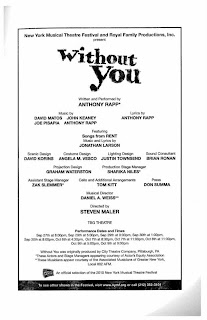
NYMF, The Barrow Group Theater

There's a scene from the television series "Six Feet Under" where a grieving woman asks the main character Nate, "Why do people have to die?" Nate considers for a moment and then replies, "To make life important."
There is something about that elemental theme - death giving shape to life - that utterly arrests me. I don't know what it is. It could be just a basic human understanding that life is fleeting. But it feels like more than that. Any story that organizes itself around this theme has the power to reduce me within moments to a quivering, tear-stained ball of emotion. It's like I'm mainlining some essential unbearableness. I become instantaneously raw. And it's not so much the dying part that does it. It's the living part. Living in the face of, the fear or, the wake of, the knowledge of, the acceptance of death - a loved one's or one's own. It's terrible yet beautiful. Death and life sharpening one another. It just undoes me.
That doesn't make me special I realize. But it does explain why I woke up with swollen turtle eyes this morning, a full thirteen hours after seeing Anthony Rapp's one man show Without You. Anthony Rapp originated the role of Mark in the musical Rent, and while that cultural phenomenon was happening to him and around him - a period already underscored by the unexpected death of Rent's creator, Jonathan Larson - Rapp's own mother was living with and eventually dying from cancer. Without You chronicles the layering of these events in Rapp's life, a confluence that is somewhat staggering. Given that I come undone by stories of death giving shape to life, and given my love affair with Rent, itself a narrative organized around this theme, I knew walking into Without You that I was hosed. And I was right. My face was simply lacquered in tears from the beginning right to the end.
Thinking back on Rapp's show, though, I realize there's another element to these narratives that sources the rawness I feel. It's not just how death and life sharpen one another, it's how death and life are each sharpened by love. It's the love. Cheesy as it sounds. When it comes to dying, love is both the source of pain, and the way through it. That seemed to be the message of Rapp's narrative, and it was also so in Rent. I suppose if dying is what makes life important, then what makes life important is love. Hey, just because it comes off cheesy written out like that in some sappy woman's blog, doesn't make it untrue. I've got the turtle eyes to prove it.
Thursday, September 23, 2010
Serendipity and Chaos: Or, How to Cure Hamster Cancer
I’m jumping off a bit of a cliff with this post – it’s the first one not centered around a specific performance – and I hope you’ll jump with me. One of my intentions for the blog this year is to allow for a little more blogginess. You know, shorter posts, less forethought, more spontaneity. My hope is that this looseness will provide some new inspiration and eventually lead me somewhere valuable that I can’t as yet predict. The “good student” in me – the girl scout who believes in responsibility and duty – is nervous that this change in affairs is simply slackerdom in sheep’s clothing. Perhaps. But you know what? Lately I’ve been telling that girl scout to stuff it. Her devotion to care and craft, while one of my greatest assets, has no doubt precluded me at times from the serendipity found in chaos. So I’m gonna have my blogginess. And if you’re a fan of my longer, more crafted writings, have no fear. Girl Scout is strong. She usually ends up winning in the end.
Speaking of “serendipity found in chaos”, let’s talk about improvisational theater – or improv – where "serendipity found in chaos" is the name of the game. I’ve been studying improv quite a bit since landing in New York and while I haven’t heard this exact phrase used to describe improv, I think it’s rather evident how it belongs. Chaos is inherent in improv. All the scenes are made up on the spot and no single performer knows what will happen next. It is, therefore, unplanned and unpredictable. Serendipity – or the phenomenon of making fortunate discoveries by accident – comes into play when the improvisers begin making connections amongst all the random material their chaos has generated. The serendipity part is what makes improv so delightful to watch. I hope you’ve all had the experience of bursting into unexpected laughter when the guy on stage suggests they cure the hamster’s cancer with that magic banana plunger from way back in the first scene. Or, you know, something similar. But the serendipity can’t happen without generating the chaos first. That’s what’s so fascinating about improv. It depends on chaos, on barreling into the unknown, and agreeing to embrace wholeheartedly whatever comes your way, no questions asked.
Does this make sense to people who haven’t studied improv? I hope so. If not, I suppose the very basic thing to know is the concept of “Yes, and,” which is how improvisers create agreement and generate new information in a scene. So if my scene partner says, “We’re plumbers,” then I must agree to that reality and also add new information: “YES we’re plumbers AND we have magical powers.” Then my scene partner does the same thing: “YES, we’re magical plumbers AND we’re stranded on a tropical island.” And before you know it, we’re going into business and magic banana plungers are born – which, as it turns out by the end of the show, are just the perfect thing to cure some poor hamster’s cancer.
Chaos is terrifying. Disorder and unpredictability, in life, is terrifying. That’s why I make lists and keep a calendar, and have perfected the art of worrying – all efforts to keep the disordered and unpredictable at bay. But if I get too good at it, all I will get out of life is exactly what is on my list plus a forehead full of wrinkles. So studying and performing improv is a bit of a balm for me. It’s a place where I can practice embracing chaos. And where I can practice creating order out of chaos not by imposing control, but by opening myself to the contributions of others and then adding my own two cents. The reward at the end of it – if I embrace and open hard enough – is serendipity and unexpected laughter, which is very tempting indeed, even for Girl Scouts. So I keep at it, even though it’s not so easy. Not so easy, but at least it’s simple. As simple as saying, "Yes, and."
P.S. - If you're in New York City or Chicago, you owe it to yourself to seek out the improv duo TJ and Dave - whose particular style of long-form improv will have less to do with magic banana plungers than with the hilarious authenticity of being human. Other improv teams I've recently enjoyed, and where magic banana plungers have a greater likelihood of appearing, include: The Stepfathers at UCB, Starkey and Grace and Jenn + Steve at The PIT, and of course Student Driver.
Speaking of “serendipity found in chaos”, let’s talk about improvisational theater – or improv – where "serendipity found in chaos" is the name of the game. I’ve been studying improv quite a bit since landing in New York and while I haven’t heard this exact phrase used to describe improv, I think it’s rather evident how it belongs. Chaos is inherent in improv. All the scenes are made up on the spot and no single performer knows what will happen next. It is, therefore, unplanned and unpredictable. Serendipity – or the phenomenon of making fortunate discoveries by accident – comes into play when the improvisers begin making connections amongst all the random material their chaos has generated. The serendipity part is what makes improv so delightful to watch. I hope you’ve all had the experience of bursting into unexpected laughter when the guy on stage suggests they cure the hamster’s cancer with that magic banana plunger from way back in the first scene. Or, you know, something similar. But the serendipity can’t happen without generating the chaos first. That’s what’s so fascinating about improv. It depends on chaos, on barreling into the unknown, and agreeing to embrace wholeheartedly whatever comes your way, no questions asked.
Does this make sense to people who haven’t studied improv? I hope so. If not, I suppose the very basic thing to know is the concept of “Yes, and,” which is how improvisers create agreement and generate new information in a scene. So if my scene partner says, “We’re plumbers,” then I must agree to that reality and also add new information: “YES we’re plumbers AND we have magical powers.” Then my scene partner does the same thing: “YES, we’re magical plumbers AND we’re stranded on a tropical island.” And before you know it, we’re going into business and magic banana plungers are born – which, as it turns out by the end of the show, are just the perfect thing to cure some poor hamster’s cancer.
Chaos is terrifying. Disorder and unpredictability, in life, is terrifying. That’s why I make lists and keep a calendar, and have perfected the art of worrying – all efforts to keep the disordered and unpredictable at bay. But if I get too good at it, all I will get out of life is exactly what is on my list plus a forehead full of wrinkles. So studying and performing improv is a bit of a balm for me. It’s a place where I can practice embracing chaos. And where I can practice creating order out of chaos not by imposing control, but by opening myself to the contributions of others and then adding my own two cents. The reward at the end of it – if I embrace and open hard enough – is serendipity and unexpected laughter, which is very tempting indeed, even for Girl Scouts. So I keep at it, even though it’s not so easy. Not so easy, but at least it’s simple. As simple as saying, "Yes, and."
P.S. - If you're in New York City or Chicago, you owe it to yourself to seek out the improv duo TJ and Dave - whose particular style of long-form improv will have less to do with magic banana plungers than with the hilarious authenticity of being human. Other improv teams I've recently enjoyed, and where magic banana plungers have a greater likelihood of appearing, include: The Stepfathers at UCB, Starkey and Grace and Jenn + Steve at The PIT, and of course Student Driver.
Tuesday, September 14, 2010
Burning Man 2010: Metropolis
Burn Date: 09.04.10
Black Rock City, NV

Not everyone comes to see the Man burn. Some people leave early, the better to gain swift passage through the two lane highway out of the desert. Some remain, but at their camps or elsewhere nearby; they are spent perhaps, or simply desire something else from their evening. All of those who miss it are likely regular denizens of Black Rock City. They have seen the Man burn before. They will see him burn another year.
For the rest of us, and it feels to be all 50,000 converging upon the playa, witnessing the burn has suddenly become the very reason for being here. Seems strange to say ‘suddenly’ since this is the ritual after which the festival is named, but the week has already been replete with reasons to be here, even without tonight’s climactic event. I could have left this afternoon with that handful of others and brought back enough insight and inspiration to fuel me into winter. But now, I and thousands of celebrants are bedecked in apocalyptic finery and walking up the long radial streets of this circular city toward the Man – a glowing, summoning, blue beacon – and I cannot deny the atmosphere of pilgrimage. We were here for myriad reasons before tonight. Tonight we are here for him.
The Man stands one hundred feet high this year, a forty foot neon-lined body standing atop a sixty foot wooden base. From where we began walking, at our camp in the outer suburbs, he is a mile distant and difficult to distinguish. Now however, we are crossing the Esplanade, the innermost ring on the city grid, and the Man looms large though he is still two thousand feet away. He seems to hold us each with an invisible string, a piece of each person’s attention is so clearly fixed to him. Yet as we cross onto the playa, the wide expanse of open desert at the center of the city, the Man’s presence is nearly eclipsed by the swirling, blinking, cacophony of humans and mutant vehicles growing around him. Perhaps this is why I have not noticed until now that the Man’s arms, extended down by his sides all week, are raised above his head – the iconic gesture of Burning Man. I get chills. It is time, his arms say. It is about to happen.
 |
| Burn night 2010. Photo by David Silverstein |
This is my third burn, but my first in nearly a decade and I’ve forgotten what it’s like. The throbbing energy of tens of thousands of people, gathered for a single purpose, united in our anticipation, our excitement coursing through one another like an electric current leaping from heart to heart. We are a swarming mass of calling voices and wheeled pirate ships, thumping sound systems and fire-breathing dragons. We pulse together. We amplify each other. It’s overwhelming. It’s delirious. It’s mad. At my side are three beloved companions who have never been here before, and watching them experience this for the first time makes me glimpse what motherhood must be. I am seeing the world through fresh eyes. I’m a born again virgin.
The ceremony is beginning but I’m too far back to see. It doesn’t matter. I remember what it is – a circle demarcated around the Man, torch bearers, fire dancers – and there is something perfect about witnessing it all from this distance. More perspective and more mystery. Soon fireworks begin to sail up from the Man and the tension of the crowd elevates to a near audible hum. The display lasts a long time and is as satisfying as any Fourth of July. But it only pulls the tautness tighter. Now parts of the wooden base are on fire. The intensity of the moment is swelling in my chest. It is so full it is almost unbearable. I am thrumming. I feel the happiest I have ever been. In an instant, my senses fill with the sound, the brightness, and the wall of heat from an enormous fireball exploding at the center of the Man. For the briefest second, fifty thousand people are snapped to attention and held suspended together in fiery shock. We are daredevils shot from the canon, weightless at the tops of our arcs. And then gravity comes. And we erupt. My arms fly into the air and I scream. We are jumping up and down. We are dancing. We are releasing. He is on fire. He is burning. And we are losing our minds.
 |
| Burning Man 2010. Photo by David Silverstein |
If you can’t see this as theater, I don’t know what I can say to connect the dots. I feel this must be how theater originated way back before we had words and concepts for such a thing. Fire, community, an event, catharsis. What separates this night from theater, however - at least the theater I have known - is story. There is no single narrative of Burning Man. No single meaning or significance for why this Man burns or why we celebrate it as we do. There are rumors of genesis – that the founder Larry Harvey burned an effigy on a beach twenty five years ago to mourn a passing love affair – but this is mythology, no basis in fact. The effigy was burned, this is true, but Harvey insists it was a spontaneous act of artistic self-expression. The record leaves it at that. And so the meaning of Harvey’s act, the significance of its yearly replication, and the story told by its ritualization are left open. They are left for the participant to decide. For us to invent. The narrative is ours to dream up and then make true by bringing expressions of that narrative to the next year’s burn, and the next. This is Burning Man. A community organized around artistic self-expression and built upon the evolving mythologies of all of its participants. Burning Man is literally what you bring to it. It doesn’t exist without you.
As for me, my Burning Man narrative brews as we speak. I am moved by the size and scope of its art. Look at Bliss Dance:
As for me, my Burning Man narrative brews as we speak. I am moved by the size and scope of its art. Look at Bliss Dance:
 |
| Bliss Dance by Marco Cochrane. Photo by David Silverstein. |
I am moved by the inspiration, invention, craftsmanship, engineering, planning, and reliance on community it takes to bring this forty-foot statue to the middle of the desert and make it stand safely for all to admire and fall in love with it. Funny, that sentence could refer just as well to the Man himself. Replace “forty foot statue” with “temporary city” and it refers to Black Rock City a as whole, to the phenomenon of Burning Man itself. This is a place of impossibility made real, which means nothing in the “real” world is impossible. Nothing I can dream up need remain undone. I want to produce a play? I will do it. I want to become great at improv? I will do it. I want to exercise more? I will do it. These things are nothing when Bliss Dance is in the world. Life is easier than I think it is. I will remember that as long as I can. And when I forget, there will be next year’s burn.
Wednesday, August 25, 2010
FringeNYC: Picking Palin, Lenny's Dead, and The Hyperbolist
It’s August 22, 2010 and I have finally finished my Year of Plays. Fifty-two plays in three hundred and sixty five days and I feel fantastic. I was always confident I would pull it off – making myself accountable to you all pretty much sealed my fate on that score – but it was a big undertaking and I’m very proud to have finished. It feels momentous. Of course I’m not truly done, as there is still the matter of writing about these last three shows. Perhaps you’d like to count down with me, 3-2-1?
THREE!
Picking Palin
Performance Date: 08.18.10
FringeNYC Venue #2: Connelly Theater

Ever find yourself wondering, How the hell did Sarah Palin come into my life? I know I have. The woman is just so very special. Thankfully for those of us needing an answer, Picking Palin goes a long way toward providing one. The play takes place during the last week of August 2008, with Barack Obama poised to finally accept his party’s nomination in Denver, and the McCain camp scrambling to decide what worthy candidate will round out the Republican ticket. Under the mounting pressure of night after successful night over at the DNC – recall the huge stadium, Hillary’s unifying address, Barack reaching the apex of his political stardom – McCain’s top-level strategists duke it out in a hotel room over how best to play the election’s endgame, and who best to usher their side to victory.
I love political process stories – both real life and fictional – so I enjoyed tracking the compelling arguments that were ostensibly aired (hopefully aired? regrettably aired?) within the McCain camp before asking Palin to join the ticket. What sticks with me now, however, is the strange effect of watching a play about highly charged events that happened only two years ago. At times, it felt like reading a book with my face too close to the page – not enough distance to have a clear perspective. At other times, I felt I was walking with dinosaurs – so much has happened in our country since then that the events of the play seemed downright, even quaintly, sepia-toned. And yet it was just two years ago. The combined effect made me feel a little queasy, like walking through a funhouse hall of mirrors.
‘Queasy’ sounds like a criticism but I don’t mean it to be. In fact I find that reaction rather telling. Queasy is how I feel, for example, when I wake up the morning after a party and worry about what I said in a tipsy moment. I remember the details clearly enough to know it’s not that big a deal, but the sense of having been just a little out of control, just off-center enough to be unsure of my behavior – that makes me feel queasy. Picking Palin reveals that the last election is an analogous experience for me. I was awash in emotion during that time – the unbearable, swelling optimism that Obama inspired in me, the vitriolic scorn I felt for Palin, the disappointment that was McCain. I remember the details enough to know I wouldn’t take back anything I said or did in those days, and (in case you were wondering) I’ve been happy with the job our President has done so far. But I can also admit to that having that same sense of off-centeredness, of having been just a little bit out of control – and it was not until Picking Palin that I had occasion to notice it.
That’s a useful observation for me. I add it to my evolving perspective on politics and the media. I add it to my growing awareness that when I decide to listen to and care about the arguments presented in the political/cable news arena, I am deciding to enter a meme-war. And in meme-wars, the participants are all conscripted to serve as soldiers for one side or the other. If we have enough presence of mind – as I feel I did in 2008 – we can ensure the memes we solider for align with our values. But even when that’s the case, we’re still following orders handed down from up on high, from somewhere other than ourselves. Our words and actions are not entirely under our control. We are off our centers. And even if we don't want to change that exactly, it’s still a good thing to keep that in mind.
TWO!
Lenny’s Dead
Performance Date: 08.18.10
FringeNYC Venue #3: The Kraine Theater

This play has got me thinking about writing as catharsis. Writing as a way to purge oneself of something stuck inside. Writing as the exorcism of a story from one’s soul. It’s no wonder the play has led me here. Lenny’s Dead begins and ends with a man needing to just that – exorcise a story from his soul.
The man in question is Hank, a veteran of the Vietnam War, and the story is what really happened to his friend Lenny, killed by enemy fire thirty-nine years ago. To aid Hank in his catharsis is Lenny himself – appearing to us and to Hank as a ghost, or perhaps the embodied memory of the man. Lenny insists Hank has been hiding from the truth for far too long and he is determined to see the whole story finally come out.
Augmenting this writing as exorcism idea is the knowledge that Hank is performed in this production by the playwright himself, and that Lenny’s Dead is the gentleman’s first play. This suggests to me the possibility that the story of Hank must be, in some fashion, rooted in the facts of the playwright’s life. It must be his story that we are exorcising here. Of course I could be wrong; it could all be utterly fictional. But there was a certain innocence about the production, a guilelessness that makes me suspect I’m right.
It doesn’t matter either way. What I like is the thought of someone carrying around a bit of shadow inside him, a knowledge within himself that he doesn’t particularly want to see. And perhaps it doesn’t bother him all that much, or maybe it does, but he always knows that its there. And then, one day, rather than continuing to carry that shadow around – which is completely within his right to do – he decides instead to take a deeper look at it. To examine that place inside himself. To shine some light into that hidden space and see just what it is he finds.
What I like even more is using the act of writing to aid in that examination. I think writing is one of the best tools we humans have for self-discovery. And the more we use it for that purpose, the better we get at it. The better we get at precisely defining our thoughts, feelings, and ideas. The better we get at noticing when we have a stone left unturned within us. The more dissatisfied we are to leave those shadows there unchecked.
If you’ve never picked up a pen to sweep out those darker places inside you, I suggest you do it. It feels incredible, as I suppose all catharsis does when it is over. You don’t have to know where you’re going when you start. In fact, you don’t have to know anything at all. Just begin. You will discover what you need to along the way. And you just might surprise yourself and end up with a play.
ONE!
The Hyperbolist
Performance Date: 08.22.10
FringeNYC Venue #18: HERE Arts Center, Dorothy B. Williams Theater

I couldn’t have asked for a better show with which to end my Year of Plays. It was such a delightful experience. It had all my favorite things in it. Wit and whimsy. Words -- such words -- and wiggly eyebrows. Tradition and innovation. Craft and inspiration. Physicality, philosophy, and film. Puppets. Can’t forget the puppets. And of course at its center, the absolutely essential element for all utterly Anna-approved works of art, a great big beating heart. Love! That was the theme of the day in this collection of works by Joe Mazza. And not just any love, but pure love, fundamental love. The kind that makes you blush when you witness it in the physical intimacies of Dante and Florence, your pair of trained circus fleas.
I don’t want to share too much about this show because there are two shows left and I think you should just see it. But I will say that Joe Mazza strikes me as the kind of artist I admire most – the kind who makes whatever art is in his heart, in whatever form, for whatever reason. The kind who follows his own fun without bothering to wonder if others will come along. The kind who gets satisfaction in the doing of art, rather than in doing art “right.” Because the art he does is right, just by virtue of him doing it. He is incredibly talented -- in his writing, his puppeteering, his Keaton-esque clowning on film, his command over his body and face, his music -- and he also just seemed like a really nice guy. Greeting each of us as we sat in the theater waiting for the show to began, Mazza created an atmosphere of creative conspiracy that was warm and welcoming. He was casual, gracious and charming, with a comedic flair somewhere in the vicinity of a refined Robin Williams with a vocabulary the size of the OED. Apocape. I learned that word within four seconds of me sitting down and I knew immediately I was in for a treat.
The Hyperbolist is an entertaining little gem in the Fringe and I'm glad I found it. And I'm glad it is the production that puts the period on my playgoing project. You should check it out and maybe start a playgoing project of your own.
The Hyperbolist is an entertaining little gem in the Fringe and I'm glad I found it. And I'm glad it is the production that puts the period on my playgoing project. You should check it out and maybe start a playgoing project of your own.
HAPPY NEW YEAR!
So that’s it folks. That’s the official end of A Year of Plays. It’s truly been a pleasure writing these posts, and I hope you have enjoyed reading them. I highly recommend embarking on some similar adventure for yourself. There is nothing like immersion to teach you something new about a subject.
As for the future, my immediate plans are to go to Burning Man. Seriously. I leave on Saturday. But when I return, the blog will resume. Come on, you didn't think you could get rid of me that easily, did you? Especially not when I enjoy writing the sound of my voice so much. So meet me back here in mid-September. It will still be called A Year of Plays, but I'm relieving myself of the play-a-week structure. I do plan on keeping up the regular attendance in the theater though and I also hope to keep writing about art without reviewing it. What will change is my scope of inquiry, so to speak. I plan on loosening up on what "counts" as theater and am really looking forward to considering more unconventional forms. Burning Man of course is at the top of the list for new subjects. So you have that to look forward to.
In the meantime, please check out my upcoming appearance on the New York Innovative Theater blog -- should be up some time today. NYIT guest blogger Neal J. Freeman, a good friend and longtime collaborator of mine, interviews me about the conclusion of this year long project and about writing without reviewing it. It was a fun interview and hopefully will be an interesting read.
Until later, my friends. Thank you once again for all your support. It has meant the world to me.
Until later, my friends. Thank you once again for all your support. It has meant the world to me.
Thursday, August 19, 2010
FringeNYC: Running, Get Rich Cheating, and Tiny Geniuses
Running


Performance Date: 08.13.10
FringeNYC Venue #14: The Cherry Pit
Get Rich Cheating
Performance Date: 08.15.10
FringeNYC Venue #16: The Soho Playhouse

Tiny Geniuses
Performance Date: 08.15.10
FringeNYC Venue #17: Here Arts Center Mainstage

Welcome to the last two (official) weeks of A Year of Plays. Thankfully, these weeks coincide with the New York International Fringe Festival, when the city has plays coming out its ears every moment of the day. If I’m a woman of my word, and I mean to be, I’ve got six shows to see before August 23rd. Thus I am pleased as punch that this past weekend I saw three of them.
I should warn you though that I am currently in a fog of psychosomatic illness. I decided last night to take a sick day today because I was starting to feel run down. I imagined I would spend it as a productive mental health day – sleep late, wake up refreshed, tidy the house, work out, catch up on the To Do list. Instead, my brain heard “sick day” and figured it needed to actually make my body sick. Funny little brain. So now I feel sort of thick-tonsilled and fuzzy-headed which is making it difficult to weave a cohesive thesis out of my Fringe experience thus far.
All the same, I do feel that these three shows – as far-ranging as they are in style – each made me alight near the topic of naturalism. I’m not sure that’s the right word, so I’ll also throw in the adjectives real, believable, and authentic. I fear I’m in danger of making you fuzzy-headed too, so let me dive in, tackling each show on its own.
Running
Get Rich Cheating is my friend Jeff Kreisler’s one man show, billed as a Tony Robbins-type wealth-building seminar that promises to make your greedy little dreams come true through some good old fashioned cheating. Rife with examples of real-life cheating “heroes” such as Bernie Madoff, AIG, and A-Rod, the show is a flat out satire – but of a surprisingly natural kind.
Jeff has a formidable intelligence, a robust moral center, and a wicked sense of humor. These combine perfectly to create the ironic social commentary that blazes, nearly undisguised, behind his character’s cherubic grin. Yet at the same time, Get Rich Cheating as a seminar feels disturbingly believable, as if it’s just a hair away from being an actual self-help phenomenon that could be sweeping our helpless nation tomorrow. In fact, if you took the glint of intellect from Jeff’s eyes and replaced it with a vacuous sincerity, I would not be surprised to find this show on TV in the wee hours, right between the DebtBuster infomercial and the Shake Weights for Men ad. It’s a bizarre duality. A show that is clearly not what it says it is, and yet is this close to being so. I attribute that to shrewd observance on the part of the show's creative team as well as to the bleak reality of our current culture.
Thinking about that “life-sized” idea again, here is a show that takes a real life truth and translates it through satire, character, and humor. There is nothing actual-life-sized about it. Except, except… I do think it’s worth noting that a few of my favorite moments were when Jeff was playing off-the-cuff with members of the audience, and engaging in some real-time, real-life interaction. Jeff remained in character and therefore within the parody, so perhaps those moments can’t be called “actual-life-sized.” But they did have an authenticity – an actualness – that deeply appealed to me.
By the way, actualness? Who do I think I am? Stephen “Truthiness” Colbert?
Tiny Geniuses
Gosh I just really liked this show. It was just super duper delicious and fun. For starters, everyone in it looked so shiny and new and impossibly young, which is sort of unsettling because I could have sworn I was too young to think any adult person was impossibly young. But they had more going for them than their youth. They were terrific actors, all of them. They displayed playful comedic chops, open emotional access, and authentic moment-to-moment interaction. They were grounded and aware. They handled the absurdist aspects of the play with confidence, balancing exuberance in some moments with restraint in others. Their ensemble connection was undeniable. They were authentic. They were having fun. And despite this embarrassment of riches, there seemed to be nothing smug about them. They just seemed to be doing what they enjoyed to do. Though perhaps if they catch wind of all this effusive praise I’m throwing their way, maybe some smugness will come upon them.
Tiny Geniuses is a comedy about an elementary school for the gifted that has been corrupted by the insecure, narcissistic, and down right batty adults that run the little brainiacs' lives. Nearly all the characters in this play might be classified as over-the-top whack jobs if it weren’t for the fact that they’re so delightfully human. There’s the insecure Principal Pineapple who is so pathologically lonely she conducts a romance with her companion teddy bear. There’s the wealthy Mommy and Daddy who sling their venomous banter just slightly over their young daughter’s head. And there’s the combined innocence and cruelty of the Gateway School’s children, played believably yet with clownish skill by the adult cast. And then at the center of this stylized maelstrom is the charming Finola Applebaum, a teacher with a heart of gold and our relatable straight-man in this sea of insanity.
I find the juxtaposition of outsized abusrdism and relatable naturalism really intriguing in this show. I feel it is handled very well. Ms. Applebaum's character – as "real-life" as she seems – always remains within the absurd world of the show. Her character never comments on the wackiness around her, but deals with it authentically, as it were all just a part of her ordinary life. A similar juxtaposition can be found within each character portrayal as well. In one moment, you gape at the playground tyrant as she viciously blackmails Ms. Pineapple by threatening to withold the principal's regular cootie shot, and in the next moment, you witness the child's genuine hurt at her self-involved mother's neglect. It's a delightful little magic trick to watch the style change so seamlessly moment to moment.
So there we have it. Three shows down and three to go. This whole life sized/real life/naturalistic/authentic thread is a bit of a tangled mess, but there are some good strands in there to keep tugging on. Particularly the bias against "life-sized" theater. I'm pretty sure there are a couple different concepts I currently have confused and need to separate within that argument. Stay tuned.
I should warn you though that I am currently in a fog of psychosomatic illness. I decided last night to take a sick day today because I was starting to feel run down. I imagined I would spend it as a productive mental health day – sleep late, wake up refreshed, tidy the house, work out, catch up on the To Do list. Instead, my brain heard “sick day” and figured it needed to actually make my body sick. Funny little brain. So now I feel sort of thick-tonsilled and fuzzy-headed which is making it difficult to weave a cohesive thesis out of my Fringe experience thus far.
All the same, I do feel that these three shows – as far-ranging as they are in style – each made me alight near the topic of naturalism. I’m not sure that’s the right word, so I’ll also throw in the adjectives real, believable, and authentic. I fear I’m in danger of making you fuzzy-headed too, so let me dive in, tackling each show on its own.
Running
This play is essentially a long conversation between a man and a woman over the course of a single night. It’s performed by two veteran actors whose ease on stage is apparent the moment they make their entrance together, mid-dialogue. This ease was so great that, at moments, their performances were nearly indistinguishable from real life, as if the audience were listening in on two people’s actual interaction. It was very finely acted – I was particularly enamored of the male actor’s subtle specificity – and yet I wasn’t sure how to feel about the eavesdropping nature of my experience. Not because I felt I was intruding on a private moment, but because historically I’ve considered vérité a liability in theater.
It has been my unchecked belief that theater is not meant to be actual-life-sized. That theater is not meant to replicate life, but to translate it somehow. Make it bigger, make it smaller. Distill it, decorate it, distort it. Shove it through a new lens, like Play-Doh through the Fuzzy Pumper, and extrude it into a new shape. Even when the chosen style of a piece is naturalism (or realism or whatever the proper dramaturgical term is), I’ve always believed it must not be exactly like “real life.” Indeed, the very nature of theater – that there are performers, an audience, a tacit agreement about why we’re there – prevents it from being exactly like real life. (Except when “real life” is going to or performing in a play, but we’ve already covered that postmodern ground together.) When actors seem to ignore this fact, the result feels too private and indulgent for me, as if the performer couldn’t care less that I was there at all. And I guess I take that personally. So I’ve always preferred that performances and productions embrace their not-realness, and that actors lift their energy, even slightly, to include me.
However, this actor in Running – I don’t think I can say his energy on stage was any higher than it would be for a man having a late night conversation with a woman in his apartment. And yet as I said, I was enamored of his performance all the same. I did not find it too private or indulgent. I felt included in his awareness. So I’m a bit at a loss—still confused. Are my tastes for “life-sized” theater changing? Or was this piece of theater, and this man’s performance, not actually life-sized? I think maybe both. I’m just not sure in what proportions.
Get Rich Cheating
It has been my unchecked belief that theater is not meant to be actual-life-sized. That theater is not meant to replicate life, but to translate it somehow. Make it bigger, make it smaller. Distill it, decorate it, distort it. Shove it through a new lens, like Play-Doh through the Fuzzy Pumper, and extrude it into a new shape. Even when the chosen style of a piece is naturalism (or realism or whatever the proper dramaturgical term is), I’ve always believed it must not be exactly like “real life.” Indeed, the very nature of theater – that there are performers, an audience, a tacit agreement about why we’re there – prevents it from being exactly like real life. (Except when “real life” is going to or performing in a play, but we’ve already covered that postmodern ground together.) When actors seem to ignore this fact, the result feels too private and indulgent for me, as if the performer couldn’t care less that I was there at all. And I guess I take that personally. So I’ve always preferred that performances and productions embrace their not-realness, and that actors lift their energy, even slightly, to include me.
However, this actor in Running – I don’t think I can say his energy on stage was any higher than it would be for a man having a late night conversation with a woman in his apartment. And yet as I said, I was enamored of his performance all the same. I did not find it too private or indulgent. I felt included in his awareness. So I’m a bit at a loss—still confused. Are my tastes for “life-sized” theater changing? Or was this piece of theater, and this man’s performance, not actually life-sized? I think maybe both. I’m just not sure in what proportions.
Get Rich Cheating
Get Rich Cheating is my friend Jeff Kreisler’s one man show, billed as a Tony Robbins-type wealth-building seminar that promises to make your greedy little dreams come true through some good old fashioned cheating. Rife with examples of real-life cheating “heroes” such as Bernie Madoff, AIG, and A-Rod, the show is a flat out satire – but of a surprisingly natural kind.
Jeff has a formidable intelligence, a robust moral center, and a wicked sense of humor. These combine perfectly to create the ironic social commentary that blazes, nearly undisguised, behind his character’s cherubic grin. Yet at the same time, Get Rich Cheating as a seminar feels disturbingly believable, as if it’s just a hair away from being an actual self-help phenomenon that could be sweeping our helpless nation tomorrow. In fact, if you took the glint of intellect from Jeff’s eyes and replaced it with a vacuous sincerity, I would not be surprised to find this show on TV in the wee hours, right between the DebtBuster infomercial and the Shake Weights for Men ad. It’s a bizarre duality. A show that is clearly not what it says it is, and yet is this close to being so. I attribute that to shrewd observance on the part of the show's creative team as well as to the bleak reality of our current culture.
Thinking about that “life-sized” idea again, here is a show that takes a real life truth and translates it through satire, character, and humor. There is nothing actual-life-sized about it. Except, except… I do think it’s worth noting that a few of my favorite moments were when Jeff was playing off-the-cuff with members of the audience, and engaging in some real-time, real-life interaction. Jeff remained in character and therefore within the parody, so perhaps those moments can’t be called “actual-life-sized.” But they did have an authenticity – an actualness – that deeply appealed to me.
By the way, actualness? Who do I think I am? Stephen “Truthiness” Colbert?
Tiny Geniuses
Gosh I just really liked this show. It was just super duper delicious and fun. For starters, everyone in it looked so shiny and new and impossibly young, which is sort of unsettling because I could have sworn I was too young to think any adult person was impossibly young. But they had more going for them than their youth. They were terrific actors, all of them. They displayed playful comedic chops, open emotional access, and authentic moment-to-moment interaction. They were grounded and aware. They handled the absurdist aspects of the play with confidence, balancing exuberance in some moments with restraint in others. Their ensemble connection was undeniable. They were authentic. They were having fun. And despite this embarrassment of riches, there seemed to be nothing smug about them. They just seemed to be doing what they enjoyed to do. Though perhaps if they catch wind of all this effusive praise I’m throwing their way, maybe some smugness will come upon them.
Tiny Geniuses is a comedy about an elementary school for the gifted that has been corrupted by the insecure, narcissistic, and down right batty adults that run the little brainiacs' lives. Nearly all the characters in this play might be classified as over-the-top whack jobs if it weren’t for the fact that they’re so delightfully human. There’s the insecure Principal Pineapple who is so pathologically lonely she conducts a romance with her companion teddy bear. There’s the wealthy Mommy and Daddy who sling their venomous banter just slightly over their young daughter’s head. And there’s the combined innocence and cruelty of the Gateway School’s children, played believably yet with clownish skill by the adult cast. And then at the center of this stylized maelstrom is the charming Finola Applebaum, a teacher with a heart of gold and our relatable straight-man in this sea of insanity.
I find the juxtaposition of outsized abusrdism and relatable naturalism really intriguing in this show. I feel it is handled very well. Ms. Applebaum's character – as "real-life" as she seems – always remains within the absurd world of the show. Her character never comments on the wackiness around her, but deals with it authentically, as it were all just a part of her ordinary life. A similar juxtaposition can be found within each character portrayal as well. In one moment, you gape at the playground tyrant as she viciously blackmails Ms. Pineapple by threatening to withold the principal's regular cootie shot, and in the next moment, you witness the child's genuine hurt at her self-involved mother's neglect. It's a delightful little magic trick to watch the style change so seamlessly moment to moment.
So there we have it. Three shows down and three to go. This whole life sized/real life/naturalistic/authentic thread is a bit of a tangled mess, but there are some good strands in there to keep tugging on. Particularly the bias against "life-sized" theater. I'm pretty sure there are a couple different concepts I currently have confused and need to separate within that argument. Stay tuned.
Subscribe to:
Posts (Atom)


