Tuesday, August 3, 2010

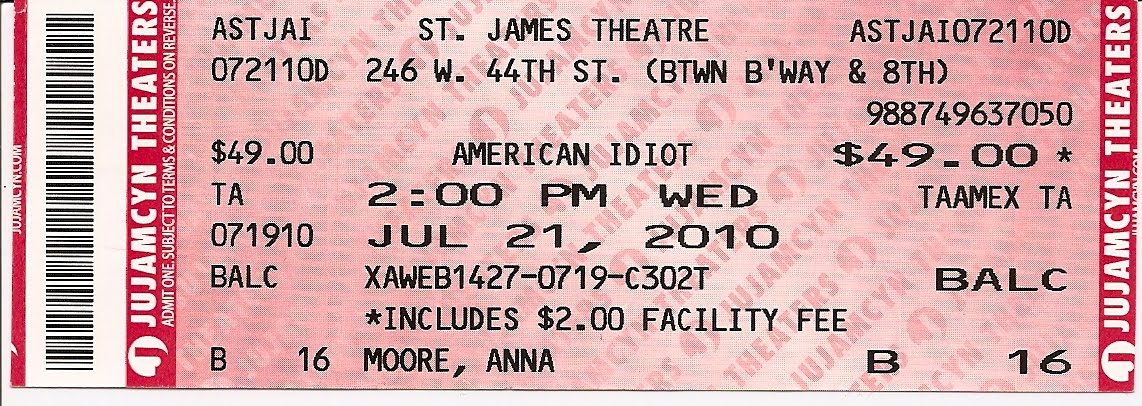
American Idiot

Performance Date: 07.21.10
St. James Theatre


I tried to make this post on Green Day’s American Idiot about narrative, but it didn’t work. I was probably over-reaching or maybe I was just tired, but either way, I came off sounding like a first year grad student talking out her ass to her Freshman Lit students. Making up all kinds of definitions, generalizing based on hunches gleaned from personal experience, blathering about narratives of plot, personal narratives, and cultural narratives. It was all pomp and no circumstance, and before I got too far my Yada Yada Yada ref threw a yellow card and I had to toss the whole thing out. So Instead, I will tell you this:

In 1994 and 1995, I listened to Green Day’s breakthrough album “Dookie” on a constant loop. I was a sophomore in college. The album made me feel punk when I was decidedly suburban, which I think is an exact reflection of Green Day’s place in the cultural landscape at that time. I knew that Green Day was about as lightweight as you could get in the punk universe without completely ejecting from it, but that didn’t matter in the slightest. “Dookie” made me feel rebellious, alienated, and edgy, and that was exactly what this nineteen-year-old Dean’s List student from Palo Alto needed. Listening to Green Day made me feel that there was more to me than met the eye.

In 1998, my friend Sally took me and twenty of our coworkers to see the musical Rent in Reno. She had been a devoted fan since the first national tour kicked off in her college town and had already seen the musical some 15 times. By the time our caravan of twenty-somethings left that fair city, I was similarly hooked. The central anthem of the musical, “No Day But Today,” twanged a chord in me that I still find hard to describe. Top notes plucking the exuberant yearning of my inner infatuation-addicted teenagerRoger loves Mimi but he’s afraid! – and bottom notes thrumming more philosophically to themes of choosing innocence in the face of cynicism, and optimism in the face of pain. Over the next few years, I too saw the musical nearly 15 times.

In 2001, September 11th happened and so began many years of me struggling to comprehend what the f*ck was going on in the world. In the immediate aftermath, I could not saturate myself deeply enough with the images and stories from the attack. I watched the news obsessively, thirsty for and yet horrified by each new video that captured another perspective on the explosions, the billowing plumes of smoke, the people falling, the streets below. In those few days, the television felt like a tribal elder passing on a history that I was duty-bound to remember. But that quickly changed. I soon learned that the TV was not to be trusted, even as my dependence on it deepened, and that nobody on TV was to be trusted either.

This post is about narrative after all. These three narratives from my life explain perfectly why American Idiot resonated so successfully with me, despite the musical lacking a strong theatrical narrative to tie Green Day’s songs together. Traditional narrative (the story of what happens) isn’t the only way to engage an audience. Reflecting an audience member’s personal narrative (the story of me) or a cultural narrative to which she feels attached (the story of us) can work just as well. Hearing the tight harmonies and driving percussion of Green Day’s music blaring from the stage connected me to that nineteen-year-old trying a new identity on for size. Appreciating the rocking-out performance style and multi-level scaffolding set that American Idiot shares with its predecessor Rent connected me to the exhilaration of that long dormant rock musical addiction. Seeing a wall of television screens replay the imagery of this past decade’s media history, hearing the lyrics of political dissent and social unrest, and watching a projection of a skyscaper's worth of loose leaf paper blowing in the air – these experiences clearly connected me with our country’s journey in the years since 9/11. None of these elements from American Idiot tell the story of what happens to the characters on stage, but for this individual, they do tell in part the story of me and the story of us. And that kept me engaged.

Wednesday, July 21, 2010

Henry VI, Part 3

Performance Date:
Wide Eyed Productions

You have to, you just have to.  If you’re doing an epic War of the Roses Shakespeare play, with all the battle and all the blood, with all the power that changes hands, with all that drama – you just have to do what Wide Eyed Productions did with Henry VI Part 3.  You gotta go big.  Go big or go home.  But how do you do that on a showcase budget?  Wide Eyed did it like so:

With Actors Who Will Pretend Mightily

One my earliest and most influential acting teachers, Chris Herold, once said that to act is to “pretend mightily.”  I’ve always loved that phrase.  It gets at that sense of play, reminding us of when we could spend hours fully absorbed in our make believe, but ennobles it somehow.  It’s that word – mightily.  It takes the word “pretending,” which can be used to dismiss acting as deceptive, childish, or insubstantial, and gives it power.  To pretend mightily.  As though the act of holding oneself within imaginary circumstances were a great test of will, requiring a person of extraordinary strength and admired ability.  And so, in fact, it is.

Such admired actors, such mighty make believers, were among the huge cast of Henry VI Part 3.  Rather than shy away from the dramatic tenor of the play, these actors immersed themselves in it.  Rather than be embarrassed by the emotional hugeness of their characters, these actors embraced it.  Rather than pull Shakespearean extremity down to a supposedly more modern size, these actors strove to fill it.  And they did so by surrendering to the power of their imagination, with sincerity and seriousness.  It was a welcome sight.

With Design that Does Double Duty

I love elegance and efficiency.  And that’s how I felt about the two major design elements of this play – a giant wooden chair and a huge wallpaper portrait.  The chair – an enormous, tall, heavy-looking thing, with thick, square proportions – is first used as Henry’s throne, which gets usurped again and again during the course of the play.  Subsequently, however, the chair is moved, spun, laid on its back, on its side – and thus becomes a battlement, a molehill, a prayer bench.  The best part though is that these transitions are accomplished by a lone chorus member, dressed ethereally in white, who effortlessly and balletically uses his body to leverage, twist, topple, and gently lay the chair in position.  Just with that much, I’m counting four duties that chair is performing.  1) Looks beautiful and is good design.  2) Serves as actual throne.  3)  Represents multiple non-throne objects and locations.  4) When moved, symbolizes the monarchy in this play, so easily manipulated, toppled, and repositioned.

Same with the wallpaper.  It's an enormous photograph of Henry the Fifth, our Henry’s dead father, blown up to larger-than-life, Lancaster-legacy-looming-over-your-son's-throne size and pasted on the back wall of the theater.  Already that wallpaper is 1) smart design, efficiently filling an otherwise empty space, and 2) communicating the circumstances of our current king's reign as the play begins.  But then, at a key moment when the Lancaster power is crumbling, you hear this creepy, slow ripping sound, and you notice that our lone chorus member is up on a ladder tearing a great sheath of the Henry V wallpaper away.  A chilling moment.  And now the wallpaper 3) produces great sound effects, and 4) symbolizes the peeling away of Lancaster power.  Pretty cool, huh?

With Direction that Dares

I can’t remember if I’ve said this in another post, but I actually find it difficult to tell what counts as “direction” when I see a play.  As an actor in the rehearsal room, I know very well what a director is responsible for in a production.  It ranges from nearly everything to almost nothing, depending on your director.  But when I take in a play I've nothing to do with, it’s harder to determine whose ideas and choices and concepts I’m looking at.  That said, I’m going to ascribe to the director of Henry VI Part 3 the choices involved in the very last moment of the play.

But first, SPOILER ALERT.  You can still see this show this weekend, so if you’re going to go, stop reading now and experience the fun for yourself.  Again, SPOILER ALERT.  Okay, last moments of the play.  Henry is dead in the corner of stage, dripping with blood in a very awesome way that I won’t describe in case you’re still reading this even though you’re going to see it and I said SPOILER ALERT.   So stop reading now, for reals, because onto the otherwise open playing space now dashes Richard! – as in soon to be Richard the Third – butt naked!  And brandishing a knife!  He vaults himself around behind the giant chair, now laying on its side, and with a glorious spot bathing his muscley, Yorky arms in a sunny, summery light, he purrs the first two lines of his own eponymous play.  But wait!  He’s not done.  Now he reaches down behind the chair with his knife, and you think oh my god he’s going to castrate himself just as his arm gives a horrifyingly hidden yank.  But instead of revealing an awful act of self-violence, he pulls out from behind the giant chair the throne’s cushion. And with gooey tension in his movement, he stabs the cushion with his knife, rips out some stuffing, coaxes a piece of it into his smugly smiling mouth, and commences on a nice…  long… chew… as the lights slowly fade to black.  WOW.  I mean, wow.  COME ON!  You gotta admire that.  I have no idea if this moment actually “works” and I really don’t care.  Because that’s what I’m talking about right there!  Go big or go home!  The birth of a villain treated with unabashed theatricality and delivered with absolute commitment.  Balls to the wall.  (Not technically a cheap laugh since that phrase does not actually refer to male anatomy.)

So that’s my sermon for the day, ladies and gents.   Pretend mightily.  Be efficient and elegant.  Go big or go home.  Balls to the wall.

And that's all she wrote.

Thursday, July 15, 2010

Race

Performance Date: 07.14.10
Ethel Barrymore Theatre

Usually I wait at least a couple days after seeing a play to start writing about it, but today I’m trying a different tack. This afternoon I saw a matinee of David Mamet’s Race, which has been extended on Broadway with a brand new cast featuring Eddie Izzard, whom I adore, Dennis Haybert of “24” and those All-State commercials, Afton C. Williamson, and original cast member Richard Thomas, who, in addition to a vast number of laudable credits, once played John-Boy on “The Waltons”. Now it is a few hours later and I sit on my couch, laptop on lap, ready to jot down some fresh-off-the-presses, probably ill-considered, but certainly genuine thoughts.

The play is about prejudice, so let’s start with some of mine. I was predisposed not to like this play, based purely on hearsay and a bad taste left in my mouth after Mamet spent an hour with us students in grad school. He came off, frankly, as kind of an ass. I mean, I’m sure he’s a really nice man and all, but he came off as kind of an ass. I also find Mamet’s distinctive manner of writing dialogue a hard style to pull off. When it’s working, it’s undeniable and amazing – fast-paced, rhythmic, and satisfying on a deep guttural level. But when it’s not working for whatever reason, it sounds like people throwing typewriters at each other. Or maybe like people printing their thoughts out on dot-matrix printers, ripping the perforated paper off, walking across the room, and reading them aloud in front of the other person.

To add insult to injury, I was further prejudiced by the belief that Mamet’s writing gets the shortest shrift when Mamet himself directs. This is probably residue from the offense I took at Mamet’s oft-cited assertion that since the playwright has already done the work, all actors need to do is just “say the lines.” I think he actually repeated this statement at my grad school which is probably one reason I found him obnoxious. Of course, then I actually read Mamet’s True and False and I now find his advice, when taken in context, rather brilliant. But sometimes I forget I find it brilliant and my prejudice resurfaces.

Oh and then finally, finally, I thought since it was Mamet and the play was called Race and that it was about race that it would be really mouth-piecey and bludgeony and heavy-handed. Don’t know how I formed that assumption exactly, but I guess that’s the deal with prejudices.

But prejudices be damned, I liked the play. It’s imperfect and not Mamet’s most elegant work, but I liked it. Mamet is nothing if not intelligent, and I enjoy the kind of smart debate that is so often featured in his works. This play was no exception. And despite my fears of bludgeoning, I actually appreciated the unabashed and direct approach to a subject – race – that we tend to talk about only indirectly and with great caution. I also liked how, in addition to race, the play spoke to the similarities between the judicial system and entertainment. As Izzard’s character suggests, both arenas hinge on how a narrative is told to a group of people, be they audience or jury, and success depends on how that group receives and judges that narrative. This notion was further highlighted by the set, which takes a typical book-lined, mahogany law office and surrounds it with three huge banks of Broadway flood lights. And finally, I liked the cast. There was some dot-matrix printing happening right at the outset – which had me fantasizing that Mamet actually tells his actors to speak without affect – but they soon settled into a good Mamet groove, which then allowed each actor’s individual charms to shine through.

Funny how that is with Mamet. As an actor, you very often want to tear your hair out when you start working on his plays. His rhythms are so particular that even if you can hear the character speaking in your head, when you yourself try to say the words aloud, it feels stilted and phony. The words seem to block you from your instincts and you find yourself thinking, “Nobody really talks like that.” You feel like a really bad actor. So you struggle and fight with the language, trying to make it your own, but it only gets worse. And then eventually, probably just from pure repetition, you start to tap into the rhythm of his writing. You start to understand how it flows and you begin internalizing it. And finally, once you’ve truly embraced his rhythms, it all unlocks. Your instincts are suddenly available to you again and you’re free to follow your impulses, be spontaneous – you’re free to act. But you have to surrender to the language first. That’s the funny part: only by surrendering to Mamet’s unique, specific style can you bring your own unique, specific self to the role. A very strange but very rewarding experience, and I think partly what Mamet had in mind with his “say the lines” bit.

I think this gets at what I love most about acting. I love collaborating with a playwright, dead or alive, who has a strong take on language. I love the structure it provides, the parameters, the scaffolding it gives me to climb. I love working within those constraints, the constraints of someone else’s aesthetic. Without that force to push against, I often feel lost. Without that flint to strike against, my creativity doesn’t always spark. That probably has more to do with my personal psychology than anything else, as there are plenty actors who feel exactly the opposite. Plenty actors loathe constraint, and feel much more able to express their creativity on a blank canvas. But for me, I need something to grab onto, to sink my teeth into, someone else who will fight back. And if it’s not a playwright, then it’s a director with a strong vision or a scene partner with a fierce point of view. I’m not sure who or what that force will be as I begin writing material for myself. Perhaps that person will be me. I might have to split myself in two and do some battle da solo. Could be dangerous. Could be fun. Could be dangerous fun.

So there’s not going to be a snappy close for me today because, instead, I need to share this bit of information gleaned from today’s Playbill and it has nothing to do with anything. Here it is: Eddie Izzard ran 43 marathons in 51 days for charity. That’s crazypants right there. That’s bananagrams. He’s already the funniest man alive. And the smartest. He needs to stop it. Like right now. Seriously.

Friday, July 9, 2010

Candide

Performance Date: 06.19.10
The Gallery Players

I was once complimented on my rhymed couplets at an audition.  This filled me with the same amount of pride as when, at three years old, I was complimented by a waitress at the Hungry Hippo on how well I twirled my spaghetti.  So I feel I am well-qualified to offer the following observation: you know rhymed couplets are written and spoken well when it feels like you are whitewater rafting.  That I’ve never been whitewater rafting I hope does not undermine my credibility in making this statement.

The metaphor came to me while watching a new adaptation of Candide at the Gallery Players.  The verse was flowing fast and fierce, just as it should be in a snappy satire like this one, and my ears were pleased by the rhymes popping out here and there.  They were given just the right touch of emphasis – not so much as to interrupt the flow or bludgeon the listener, but not so little as to slide by unnoticed. And then I realized that my ears were actually more than pleased.  They were actually looking forward to the rhymes, looking out for them, and using them to help my brain follow along in the tumbling rapids of exposition and quickly moving plot.  In other words, the verse was the current in which I was zipping along, and the rhymes were the rocks I was pushing off of with my oars to aid my progress downstream. 

I’ve never thought about rhyme in this way.  I don’t think about rhyme much at all.  It doesn’t seem to have a place in our culture today.  Which is a total lie.  Rhyme is all over the place in music and is kind of the main event in rap.  But rhyme outside of music?  Not so much.  We’ve got Hallmark, we’ve got Dr. Seuss, and we’ve got “Stop that now, I mean it.  Anybody want a peanut?”  And that’s about it. 

But maybe this was ever so.  Maybe rhyme has only ever thrived in song and it just so happens that “song” and everyday life used to overlap more.  Not that people used to walk around conversing in rhyme, or anything, and now there’s this dearth of it that old folks bemoanBack in the day we used to appreciate rhyme structure!  If you can’t use it properly, I’ll hit you with this crutch here!   But it seems to me that rhyme was once a more highly appreciated form of wit and entertainment than it is today.  Today, outside of music, it just seems hokey.  And the idea of seeing a play written in rhymed couplets probably inspires most people to bring a pillow and blankey to the theater.  

But it shouldn’t be this way!  Rhymed couplets are fun!  Oh god, look at me. I’m a nerdy, hokey, old person bemoaning a lack of appreciation for rhyme in theater these days.  How attractive.  But let me own that for a second and say this.  What I liked about the rhyming in Candide was that it worked in partnership with the other elements in the script.  Rhymes were advanced when needed – to make a point, to highlight or a joke or be the joke itself, or to serve as a mental assist as in my rafting analogy – and left to recede when not needed for these purposes, or when a seeming absence from rhyme would best set up a rhyming punchline down the road.  They were sort of used like a star player on a good basketball team – one who can dunk when you need him to but who also knows to pass the ball.  

That’s different from how I usually see rhyme used in music.  Rap and hip-hop prize rhyme so much that it’s often all you can hear until you have time to really sit down and listen.  And of course pop, rock, and country songs usually just reach for the low-hanging fruit, deeming flat, predictable, unnoticeable rhymes sufficient.  I enjoy the results of both of these uses, but well-written and well-performed rhymed couplets do offer a slightly different joy.  It transcends auditory pleasure and engages the brain a bit more.   Makes the brain dance about, mapping meaning and metaphor and other meta M words.  And of course there are great songwriters and hip-hop artists who use rhyme in exactly this way, but they are more the exception than the rule.

So yes.  Go.  Go see a play written in rhymed couplets.  You’ll like it.  You will.  Listen to your old, hokey, nerdy grandma.  She knows what’s good for you.  And for god's sake, eat something.  You look so pale!

Thursday, July 1, 2010

A Midsummer Night's Dream

Performance Date: 06.16.10
Mortal Folly Theatre


A Midsummer Nights’ Dream is many people’s first experience with Shakespeare, and it was an early one of mine. In third grade, the sixth graders mounted a production of Midsummer, and I remember Bottom, transfigured with the head of an ass, entering the scene in which Titania falls in love with him. He was humming the theme song from “The Smurfs” and we all thought that was hysterical.

In later years, I myself appeared in two productions of Midsummer. The first production was the first play I was in since elementary school; I was a junior in high school and I played one of Hippolyta’s attendants, a non-speaking role. My costume was basically a green satin bag belted by some copper mesh with matching mesh wristbands. It was hot. I sat on a platform, along with my fellow green-satin attendant, trying to look catlike and unapproachable.

The second Midsummer was also a first -- my first show as an officially aspiring actress, about a year after taking my first acting class. I was twenty-four and I played Hermia wearing a private school uniform. Also hot. My favorite part was launching myself at Helena in the big lovers’ quarrel and I was challenged by the nightmare Hermia has just before she wakes to discover Lysander absconded. I had trouble pretending to be asleep while fighting an imaginary snake and speaking in verse. Ah, the early days.

These days most of my peers profess to have had their fill of Midsummer, but I think it is secretly a favorite play for many of them. Yes it lends itself to hokey insincerity – all that frolicking with Mustardseed in the wood – but it also holds within it a potential energy that I feel could rock me to my primal core, if only a single production could unleash it. In this dream Dream of mine, Oberon and Titania are thunderstorms of sexuality and Nature. The lovers radiate a hormonal heat that fuels their explosiveness in love, lust, and jealousy, and yet they remain uncorrupted by cynicism. Puck possesses a kinetic mystery, the fairies are both flighty and frightening, and the Mechanicals are pathetic, in the very best sense, and hilarious. It’s hard to imagine getting all of that, plus superbly handled language, plus fearsome displays of physicality, plus amazing sound, lights, and design – all essential elements in my dream Dream – together in a single show, particularly in today’s theater climate of scare resources. And thus I feel my dream Dream will always be a dream. But I plan to keep a look out.

As an aside, I feel I should mention here the 1970 Peter Brook production of Midsummer, which of course I’ve never seen, not even on tape, as recordings are very rare if they exist at all. I’ve not yet truly read up on that piece of theater history either, but its legend – as passed down in lore by the participants, or by authors and mentors who saw it firsthand – hangs over me like a tremendous specter, vainglorious and painfully out of reach. It’s infuriating that something so monumental and groundbreaking, that inspired so many legions of theater professionals and patrons throughout the world, happened five years before I was born. It’s like arriving to a party and learning that JFK, John Lennon, and Jesus just left.

At any rate. This is all to say that someone at Mortal Folly Theatre seems to have a similar dream Dream to my own. I saw and felt the intention for nearly all of my Midsummer wishes present on their stage, and the intention crystallized for me in some very memorable moments. Our first moments with Puck, for example – the sprite zipping about the stage as if made of lightening, pounding on the earth as an invocation, then leaping and freezing into a sort of crouching handstand to listen with an ear to the ground. Or the lovers, whose incredibly high-energy, knock-down brawl went farther and longer than any I’d ever seen. Or the live music, played by a cellist with a laptop, creating a depth of atmosphere that gave the giant tree tattoo across Oberon’s back a sort of tribal power. These moments, reflecting as they did my own Dream, made me feel recognized. And with each one, it was as though a little place in me sighed in relief and let go. In fact, if I remember correctly, I left the theater a little more relaxed than I entered it. Just another amazing thing that this art form can do.

Tuesday, June 22, 2010

Fences

Performance Date: 06.11.10
Cort Theatre

Let’s get the celebrity stuff out of the way first. I saw Fences the weekend before the Tony’s with a friend who knows someone in the cast. After the show, we waited in the alley behind the stage door gate to say hello. There we were had a funny exchange with fellow backstage visitor Philip Seymour Hoffman, who was not recognized by security and had to wait in the alley with us peons (he was cool about it), and were charmed by Denzel Washington who goofed with us while waiting for his cue to exit onto the barricaded street. Now, do you remember how once upon a blog I confessed that I find famous people (and Philip Seymour Hoffman in particular) shiny? Well allow me to update you: Philip Seymour Hoffman is still shiny, even up close and personal. Denzel has degrees of shininess – least shiny in person, next shiniest on stage, ultra-uber-ohmygod shiny two days later on television when I actually gasped and did a little involuntary seated-hop on my friend’s loveseat watching him on the Tony’s. I’m not proud of this last bit of information. Sometimes I think I was created in a lab by scientists.

Speaking of the Tony's...  Did Fences deserve to win Best Revival? Yes. Though View from the Bridge deserved it just as well. Did Denzel deserve Best Actor? Yes. And Liev would have deserved it too. Did Viola deserve Best Actress? Oh hell yes. Though I didn’t see any plays starring her fellow nominees. What do I think about Hollywood invading Broadway and taking all our jobs and prizes? Ah, interesting. If I became a famous movie star tomorrow, I would use my new celebrity status to enable my Broadway debut in a heartbeat. So I’m not going to say Hollywood should stay away just because I’m on the other side of it. But it is true that the commercialization of theater, and the resulting movie-and-TV-stars-on-stage phenomenon, has had a huge negative impact on my profession. There are simply fewer jobs for the non-famous, which trickles down to make competition at even the lowliest levels tougher than ever. That sucks big time. But whaddya gonna do? I don’t see the trend changing any time soon. So we will adapt. I don’t know how, nor how many careers will be abandoned in the meantime, but we will adapt. It’s the only way.

Finally, let's get to some Fences stuff. What I will remember:

-- Viola Davis’s body in a sudden, violent spasm as her character digests some devastating news. Oh my god, woman. Work. (For the uninitiated of my parents’ generation, “work” is a positive remark, derived from “work it” or “work it, girl,” commonly used in response to a person literally or metaphorically strutting one’s stuff on the catwalk.)

-- Chris Chalk’s kinetic leaping about the set as the adolescent Cory – an apt choice that, in addition to conveying his character’s youth, connected him physically to his surroundings and conveyed a sense of belonging to the home and yard around him.

-- Stephen McKinley Henderson anchoring the stage with grounded energy at the top of the show, when both Denzel and the applauding audience are forced to cope with the magnitude of Denzel’s stardom.

-- Finally Denzel Washington, who balanced an honest compassion for and honest judgment of his character, Troy Maxton, in Troy’s most unlikeable moments of the play. A less rigorous actor would be tempted to win the audience’s approval, either by evoking sympathy for Troy or subtly conveying a personal condemnation of him. Denzel does neither. His performance in those moments remains consistent with his portrayal elsewhere, and in this way he allows the complexity of August Wilson’s protagonist to shine through.

Tuesday, June 15, 2010

Everyday Rapture

Performance Date: 06.02.10
American Airlines Theatre


Everyday Rapture was completely up my alley.  I wanted to take Sherie Rene Scott home with me in my pocket.   A little pocket-sized, funny, utterly charming, sprite-like, adorable, self-deprecating, Broadway semi-star (her words) to pull out at work and put on my desk so she can sing Mister Rogers and Judy Garland songs and keep me company in my cubicle.  And then I can gaze upon her tiny sparkling eyes and her bouncy long hair, and make her tell me again about growing up half-Mennonite in Topeka and meeting a magician at the TKTS booth on her first trip to New York City.  And she can skip about the tiny stage I will make for her out of post-it notes and my paper clip caddy and her presence will remind me of four-leaf clovers and confetti.  It will be our little secret here in this grey office building in Midtown and my days here will pass like easy water flowing in a green-banked brook. 

Not that I’m writing my blog at work.

Everyday Rapture is an autobiographical one-woman musical that does indeed feature Mister Rogers, Judy Garland, four leaf clovers, and magic.  But it’s also an honest story about paradox, about struggling to move forward in life when your world view contains a vital contradiction that holds you in place – which, if you think about it, is probably something to which you can relate.  It’s one of those great, personal pieces of theater that works because the more specific someone gets in describing the truth of his or her life, the easier it is for someone listening to identify.  

Many times in the show, as she’s telling her life story, Sherie Rene Scott would have these moments where she looked like she was figuring something out.  A hesitation coupled with a puzzled frown.  A glance away followed by an intake of breath.  Those moments endeared her to me.  They made her story accessible to me.  Because in that hesitation and frown, in that glance away, I immediately recognized the quiet focus that comes over you when an important realization is just on the edge of your consciousness.  And in the intake of breath, I recognized the dawning of that realization.  I more than recognized these things.  I felt them.  I felt them with her.  And when that sort of thing happens, then this one woman’s specific, unique story of growing up half-Mennonite in Topeka lives in me for a moment.  It becomes my story, and the story of the person sitting next to me, and the story of the person sitting next to him.  Specific becomes universal.  Entertainment becomes personal.   

What’s interesting to me is that while those moments of realization were absolutely magical to me as an audience member, as an actor I also recognized them as technique.  In fact, I’m willing to bet that Sherie Rene Scott has those exact same moments of realization, with those exact expressions and movements, every evening, in every performance, at exactly the same points in the show.  Which doesn’t mean she’s faking it, by the way.  When you’re good – meaning you know exactly what you’re doing and you have strong access to your emotions – you can replicate a physical gesture day in, day out and honest emotion will come to you every (or nearly every) time.  Maybe not at 100% intensity, but it will come.

I think what I might be talking about here – both with my reaction to Sherie Rene Scott and with the ability to replicate moments of emotion on stage – is empathy.  The physical mechanics of empathy.  As in, you see in my face and body a pattern.  Your body subconsciously mirrors that pattern and recognizes it as one associated with a certain emotion.  You then feel that emotion.  So, by looking at me, you can know what I’m feeling.  (I don't know if that's exactly how it works but it sounds plausible, yes?)  So, in this way, I look at Sherie Rene Scott’s frown, glance, and breath and empathize her feeling of discovery.  And Sherie Rene Scott, looking back at some former moment in her life, mirrors the frown, glance, and breath of that moment, and she too experiences that feeling of discovery.  She empathizes with some past image of herself. 

Is that what acting is?  Empathizing with some past or imagined image of yourself?  Hm.  Well it’s an incomplete picture, to say the least.  But it’s a notion I like nonetheless.